America’s AI Workforce Reckoning: A $4 Trillion Revolution With No Playbook for the Workers Left Behind
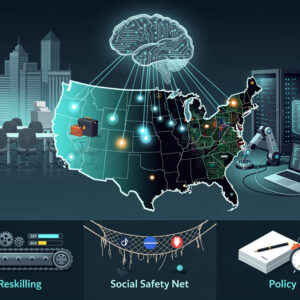
The most transformative technology of the 21st century is rewriting the rules of employment across every sector of the American economy — and neither Washington nor corporate America has articulated a coherent plan for the millions of workers whose livelihoods hang in the balance. Artificial intelligence is no longer a futuristic abstraction debated in Silicon Valley boardrooms; it is actively reshaping job descriptions, eliminating entire categories of work, and creating new roles that didn’t exist five years ago. The question that looms over the American labor market is not whether AI will change work, but whether the country is prepared for the speed and scale of that change.
A sweeping analysis published by The Atlantic paints a picture of an economy in the early stages of a profound structural shift — one that carries echoes of the Industrial Revolution but unfolds at digital speed. The piece argues that the United States lacks a comprehensive strategy for managing the labor market upheaval that AI is already beginning to cause. Unlike previous technological disruptions, which tended to affect blue-collar and manufacturing jobs, the current wave of AI-driven automation is aimed squarely at the knowledge economy — the white-collar professional class that was long assumed to be insulated from the reach of machines.
The White-Collar Workers in the Crosshairs
For decades, the conventional wisdom held that automation would primarily threaten factory floors and manual labor. AI has upended that assumption with startling efficiency. The roles most immediately vulnerable to displacement are not those of welders or warehouse workers, but of administrative assistants, customer service representatives, data entry clerks, paralegals, and even junior software developers. These are positions defined by routine cognitive tasks — precisely the kind of work that large language models and AI-powered tools can now perform at scale, around the clock, and at a fraction of the cost of human labor.
According to reporting by CNN, companies across industries are already restructuring their workforces in response to AI capabilities. Customer service departments are being hollowed out as AI chatbots handle an increasing share of inquiries. Coding assistants like GitHub Copilot and similar tools are enabling smaller teams of senior engineers to do the work that once required large cohorts of junior programmers. Financial firms are deploying AI to draft research reports and analyze data sets that previously occupied armies of analysts. The efficiency gains are real and measurable — but so are the job losses that accompany them.
Augmentation: The Promise That Comes With Caveats
Not all of AI’s impact on the workforce is destructive. Proponents of the technology — and there are many in both corporate suites and academic departments — emphasize its potential to augment human capabilities rather than replace them entirely. In this framing, AI is a powerful co-pilot that handles the tedious, repetitive aspects of a job, freeing human workers to focus on higher-order tasks that require creativity, judgment, and interpersonal skills. A consultant, for example, might use AI to rapidly synthesize market data, allowing her to spend more time on strategic recommendations for clients. A journalist might use AI tools to transcribe interviews and identify patterns in data, enabling deeper investigative work.
This augmentation narrative is not without merit. Research highlighted by the World Economic Forum suggests that in many professional contexts, AI tools are boosting productivity by 20 to 40 percent, allowing workers to accomplish more in less time. The WEF’s analysis notes that the real economics of AI and jobs are more nuanced than the binary “robots are coming for your job” headlines suggest. In sectors ranging from healthcare to engineering to creative industries, AI is enabling workers to operate at a higher level of output and sophistication. But the augmentation story has a critical caveat: when one worker with AI tools can do the job of three, the other two workers don’t simply get promoted to more interesting work. They often get laid off.
The Entry-Level Crisis Nobody Is Talking About
Perhaps the most troubling dimension of AI’s impact on the labor market is its effect on young workers and entry-level positions. These are the roles that have traditionally served as on-ramps to professional careers — the junior analyst position, the editorial assistant job, the first-year associate role at a law firm. They are characterized by tasks that are, by design, relatively routine: gathering information, drafting initial documents, managing schedules, processing data. These are precisely the tasks that AI handles most capably.
As Visionary Marketing reported in its detailed analysis of AI’s job impact, young people entering the workforce are increasingly finding that the traditional entry points into their chosen professions are being automated away. The implications extend far beyond immediate employment. Entry-level jobs are not merely about earning a paycheck; they are the crucible in which professional skills are forged, networks are built, and institutional knowledge is acquired. When those positions disappear, the entire pipeline of talent development is disrupted. A generation of workers may find themselves locked out of career trajectories that previous generations took for granted, not because they lack ability, but because the first rung of the ladder has been removed.
New Jobs Are Emerging — But Not Fast Enough and Not for Everyone
AI is not merely destroying jobs; it is also creating them. The explosion of demand for machine learning engineers, AI ethics specialists, prompt engineers, data scientists, and AI safety researchers represents a genuine expansion of the labor market. Companies are hiring AI trainers to fine-tune models, AI auditors to ensure compliance with emerging regulations, and AI integration specialists to embed the technology into existing business processes. The Bureau of Labor Statistics and private sector analyses consistently show that AI-related job postings have surged over the past two years.
But the math does not add up to a clean swap. The new jobs being created by AI tend to require significantly higher levels of technical skill, education, and specialized training than the jobs being eliminated. A customer service representative whose position is automated away cannot simply transition to a machine learning engineering role without years of additional education. The skills gap is enormous, and the existing infrastructure for workforce retraining — community colleges, corporate training programs, government-funded initiatives — is not remotely scaled to meet the challenge. As The Atlantic notes, the need for widespread upskilling and reskilling is urgent, but the mechanisms to deliver it remain woefully inadequate.
The Skills That Machines Cannot Replicate — Yet
In the emerging AI-driven economy, the most durable professional assets are those that remain stubbornly human. Empathy, complex moral reasoning, creative intuition, the ability to navigate ambiguous social situations, and the capacity for genuine interpersonal connection — these are the competencies that AI, for all its impressive capabilities, cannot convincingly replicate. Healthcare providers who must deliver difficult diagnoses with compassion, therapists who guide patients through emotional crises, skilled tradespeople who must adapt to unpredictable physical environments, and leaders who must inspire and motivate teams — these workers occupy a relatively secure position in the labor market.
The World Economic Forum has identified a shifting hierarchy of valued skills, with digital literacy, critical thinking, creativity, and adaptability rising to the top of employer wish lists. Traditional technical skills remain important, but they are increasingly table stakes rather than differentiators. The workers who will thrive are those who can combine technical fluency with uniquely human capabilities — who can use AI tools effectively while bringing judgment, context, and emotional intelligence that no algorithm can provide. This represents a fundamental reorientation of what it means to be a valuable employee, and it has profound implications for education systems at every level.
The Psychological Toll of Perpetual Uncertainty
Beyond the economic calculus of jobs gained and lost, AI’s advance through the workforce is exacting a significant psychological toll. Surveys consistently show that anxiety about AI-driven job displacement is pervasive across industries and experience levels. Workers who are not yet directly affected by automation report high levels of stress about the possibility that their roles could be next. This ambient uncertainty corrodes morale, undermines engagement, and creates a climate of fear that is itself destructive to productivity and innovation.
The phenomenon is particularly acute among mid-career professionals — workers in their 30s and 40s who have invested years in building expertise in fields that now appear vulnerable. As Visionary Marketing has documented, the fear of obsolescence is not limited to workers in obviously automatable roles. It extends to professionals in creative fields, management, and even technology itself, where the pace of change means that today’s cutting-edge skills may be tomorrow’s irrelevant ones. The mental health implications of this sustained uncertainty are only beginning to be understood, but early research suggests they are significant and growing.
Algorithmic Bias: The Hidden Discrimination Engine
As AI becomes more deeply embedded in workforce management — from hiring and performance evaluation to promotion decisions and workforce planning — concerns about algorithmic bias have moved from the theoretical to the urgent. AI systems trained on historical data inevitably absorb and perpetuate the biases present in that data. If past hiring decisions favored certain demographic groups, AI-powered recruiting tools will replicate those patterns unless specifically designed and audited to avoid them.
This is not a hypothetical concern. Multiple studies and investigative reports have documented instances of AI hiring tools that discriminate against women, people of color, and candidates from non-traditional educational backgrounds. The efficiency that AI brings to the hiring process — the ability to screen thousands of resumes in seconds — also means that biased algorithms can operate at a scale and speed that human recruiters never could. A biased human hiring manager might unfairly screen out dozens of qualified candidates; a biased AI system can do the same to thousands before anyone notices. The regulatory framework for addressing these risks remains embryonic, with a patchwork of state and local laws and no comprehensive federal legislation.
Historical Precedent Offers Cold Comfort
Optimists frequently invoke historical precedent to argue that fears about AI-driven unemployment are overblown. The Industrial Revolution, the rise of the automobile, the advent of personal computing, the internet boom — each of these technological inflection points triggered widespread anxiety about mass unemployment, and in each case, the economy ultimately created more jobs than it destroyed. The argument is that AI will follow the same pattern: short-term disruption followed by long-term expansion of opportunity.
There is some empirical support for this view. Research cited by CNN suggests that the overall impact on aggregate employment levels may be more modest than the most alarming predictions suggest. But historical analogies, while instructive, are imperfect. The speed of AI adoption far exceeds that of previous technological revolutions. The steam engine took decades to transform manufacturing; ChatGPT reached 100 million users in two months. The compressed timeline of AI’s diffusion means that workers and institutions have far less time to adapt. Moreover, previous technological transitions were accompanied by massive public investments in education, infrastructure, and social safety nets — the GI Bill, the interstate highway system, the expansion of public universities. No comparable investment is on the horizon today.
Washington’s Conspicuous Absence
The federal government’s response to AI’s workforce implications has been, to put it charitably, fragmented. While the White House has issued executive orders and established advisory committees, and Congress has held hearings featuring a parade of tech executives and academics, no comprehensive legislative framework has emerged to address the labor market disruption that AI is causing. There is no national retraining program at scale. There is no updated social safety net designed for an era of rapid technological displacement. There is no coherent strategy for ensuring that the benefits of AI-driven productivity gains are broadly shared rather than concentrated among shareholders and a technical elite.
This policy vacuum is particularly striking given the scale of what is at stake. The McKinsey Global Institute has estimated that up to 30 percent of hours worked in the United States could be automated by 2030. Even if the actual figure is half that, the implications for tens of millions of workers are staggering. As The Atlantic argues, the absence of a national plan is not merely a policy failure — it is a moral one. Workers who have played by the rules, acquired the skills that the economy demanded, and built careers in good faith are being told, in effect, that they are on their own.
Corporate America’s Mixed Signals
The private sector’s approach to AI and workforce management has been characterized by a striking disconnect between rhetoric and action. Major corporations routinely pledge to invest in worker retraining and to use AI to augment rather than replace their employees. In practice, many of the same companies are quietly reducing headcounts, restructuring departments, and using AI adoption as cover for cost-cutting measures that would otherwise generate significant public backlash.
This is not to say that all corporate retraining efforts are cynical. Some companies — particularly in technology and financial services — have made genuine investments in upskilling their workforces. Amazon’s Upskilling 2025 program, for example, has trained hundreds of thousands of employees in cloud computing and machine learning. JPMorgan Chase has invested heavily in AI literacy programs for its workforce. But these efforts, however commendable, are the exception rather than the rule. For every company investing in its workers’ futures, there are many more that view AI primarily as a tool for reducing labor costs. The World Economic Forum has noted that without stronger incentives — whether regulatory mandates or tax benefits — the market alone is unlikely to produce the scale of retraining investment that the moment demands.
The Trades and the New Premium on Physical Work
One of the more counterintuitive consequences of the AI revolution is the rising value of skilled physical labor. Electricians, plumbers, HVAC technicians, construction workers, and other tradespeople occupy a uniquely protected position in the AI era. Their work requires the kind of real-world physical dexterity, spatial reasoning, and on-the-fly problem-solving that remains far beyond the reach of current AI and robotics technology. While a large language model can draft a legal brief or write marketing copy, it cannot rewire a house or repair a burst pipe.
This dynamic is already showing up in labor market data. Wages for skilled trades have been rising steadily, and demand for apprenticeships is increasing. For a generation of young people facing the erosion of white-collar entry-level jobs, the trades offer an increasingly attractive alternative — stable employment, good wages, and a degree of insulation from technological disruption that few office jobs can match. The irony is rich: the knowledge workers who were once told they had chosen the safe, prestigious path are now looking with envy at the electrician who never has to worry about being replaced by a chatbot.
What a Real Plan Would Look Like
If the United States were serious about preparing its workforce for the AI era, what would a comprehensive strategy look like? Experts across the political spectrum have converged on several key elements. First, a massive expansion of workforce retraining programs, funded at the federal level and delivered through community colleges, online platforms, and employer partnerships. Second, a modernized social safety net that includes portable benefits, extended unemployment insurance for workers displaced by technology, and transitional income support for those undergoing retraining. Third, a reformed education system that emphasizes adaptability, critical thinking, and digital literacy from the earliest grades, rather than the rote memorization and narrow specialization that characterize much of current K-12 and higher education.
Fourth, and perhaps most controversially, a serious conversation about how the economic gains from AI-driven productivity should be distributed. If AI enables companies to produce more with fewer workers, the resulting profits cannot simply accrue to shareholders while displaced workers are left to fend for themselves. Proposals ranging from AI taxation to universal basic income to expanded earned income tax credits have been floated, but none has gained sufficient political traction to move from think-tank white papers to legislative reality. As CNN has reported, the political will to address these questions remains elusive, even as the urgency grows with each new AI capability that enters the market.
The Clock Is Running — And America Is Not Ready
The transformation of the American labor market by artificial intelligence is not a future event to be prepared for; it is a present reality to be managed. Every month brings new AI tools that can perform tasks that were exclusively human domains just a year ago. Every quarter brings new corporate restructuring announcements that cite AI efficiency as a primary driver. Every year, the gap between the skills the economy demands and the skills the workforce possesses grows wider.
The United States has navigated technological disruptions before, and it has the resources, institutions, and innovative capacity to navigate this one. But doing so will require a level of coordination, investment, and political courage that has been conspicuously absent. The workers whose livelihoods are at stake — from the young graduate unable to find an entry-level position to the mid-career professional watching AI encroach on her expertise — cannot afford to wait for Washington and corporate America to develop a plan. The technology is moving. The question is whether the country will move with it, or be moved by it.
* This article was originally published here


Comments
Post a Comment